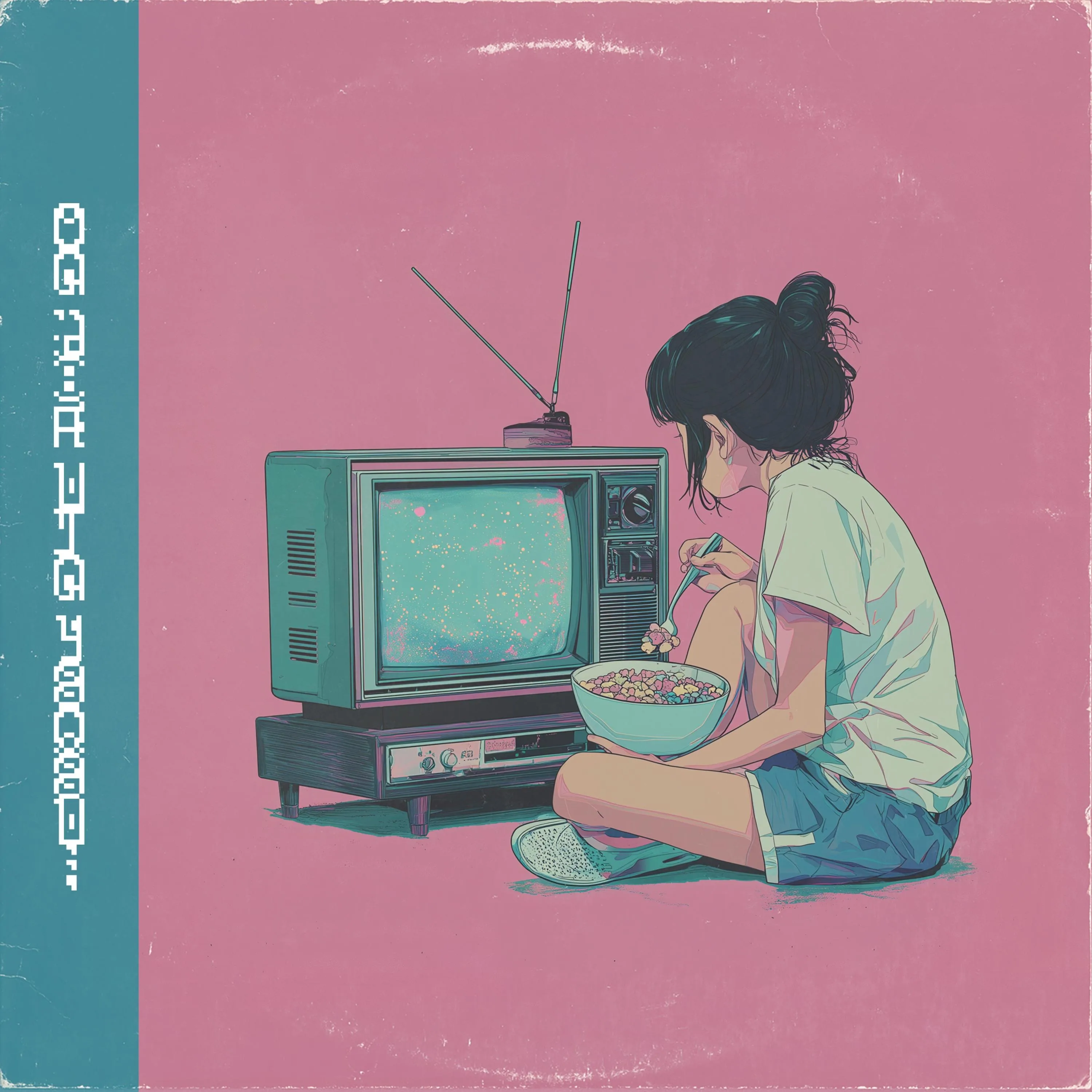
Before streaming, before every episode waited permanently on demand, Saturday morning television required a small act of faith.
You had to wake up. You had to know roughly when the good programmes started. You had to accept that if you missed something, it might simply be gone. For a child, that made the morning feel like an event. The television glowed in a dark room, the cereal bowl was too large, and the entire weekend still existed ahead of you.
Saturday Morning Cartoons captured the bright side of that memory on Wave 2. Saturday Morning Cartoons (5AM Version) moves earlier. It arrives before the theme tunes fully begin, when the house is silent and anticipation is almost stronger than the thing you are waiting for.
What is Saturday Morning Cartoons about?
The song is about childhood ritual, but the cartoons are only part of it. The deeper subject is a kind of uncomplicated excitement that becomes harder to access as time passes.
Children rarely describe this feeling as freedom. They simply live inside it. A Saturday morning can feel infinite because there are no meetings, bills, messages or obligations waiting behind the next hour. There is only the question of what will appear on screen and whether there is enough cereal left.
Looking back, the details become almost painfully vivid: the volume kept low so nobody else wakes up, blue light filling the room, adverts memorised by accident, the strange programmes shown before the main schedule begins. They were ordinary mornings. That is exactly why they matter. Nobody announces when an ordinary ritual is happening for the final time.
Why set this version at 5AM?
Five in the morning is a threshold. It is technically morning, but it still belongs to the night. The day has not formed properly yet. At that hour, familiar rooms feel different and a television screen can seem like the only awake object in the world.
The 5AM title changes the emotional camera angle. The original song remembers the colour and movement of Saturday cartoons. This version remembers the waiting. It is quieter, sleepier and more private—the sound of arriving too early because you could not risk missing anything.
The official short described it as a quieter, sleepier version, like catching cartoons before the rest of the world wakes up. That framing is important. The arrangement is not quiet simply for contrast. It recreates the physical conditions of the memory: low volume, half-light and a child trying not to disturb the house.
You can watch the official Saturday Morning Cartoons (5AM Version) short and see how naturally the visual language of television glow fits the music.
The nostalgia of waiting
Modern entertainment removes waiting whenever it can. Whole seasons appear at once. Songs arrive instantly. Algorithms continue playing before we decide what we want next. That convenience is wonderful, but it changes the shape of anticipation.
Saturday morning cartoons belonged to a schedule. The schedule made them scarce, and scarcity gave them ceremony. You could talk about the same episode at school because everybody had watched it at roughly the same time. The experience was private in the living room but shared outside it.
The 5AM Version does not argue that the past was objectively better. Nostalgia is rarely that tidy. Instead, it asks why those imperfect systems created memories that still glow. Perhaps having less control made attention feel more complete. There was nowhere else to click. You were simply there.
Why childhood media stays with us
Cartoons often become the first stories people choose for themselves. They introduce heroes, villains, friendship groups, impossible machines and worlds with their own rules. Even when the plots fade, the emotional colours remain. A theme tune can reopen a room you have not seen for decades.
That is part of the wider ME & The Robots world: old media is treated as a doorway rather than a museum piece. The point is not to collect references for their own sake. It is to ask what those references are carrying. In this song, they carry safety, excitement and the almost impossible wish to experience a familiar morning without already knowing it will end.
The memory is powerful precisely because it is small. There is no grand adventure in the room yet—only a screen warming up and a child waiting. Adulthood often teaches us to recognise importance too late. The song gives that unnoticed importance somewhere to live.
For the strongest contrast, play the original Saturday Morning Cartoons and then enter the 5AM Version. One feels like the programme beginning; the other feels like the room before it does.
Listen to Wave 2: Echoes, explore the complete EP and tracklist, or find more official clips on the videos page. If you want more songs, stories and sketches as they arrive, join the signal and unlock a free bonus song.